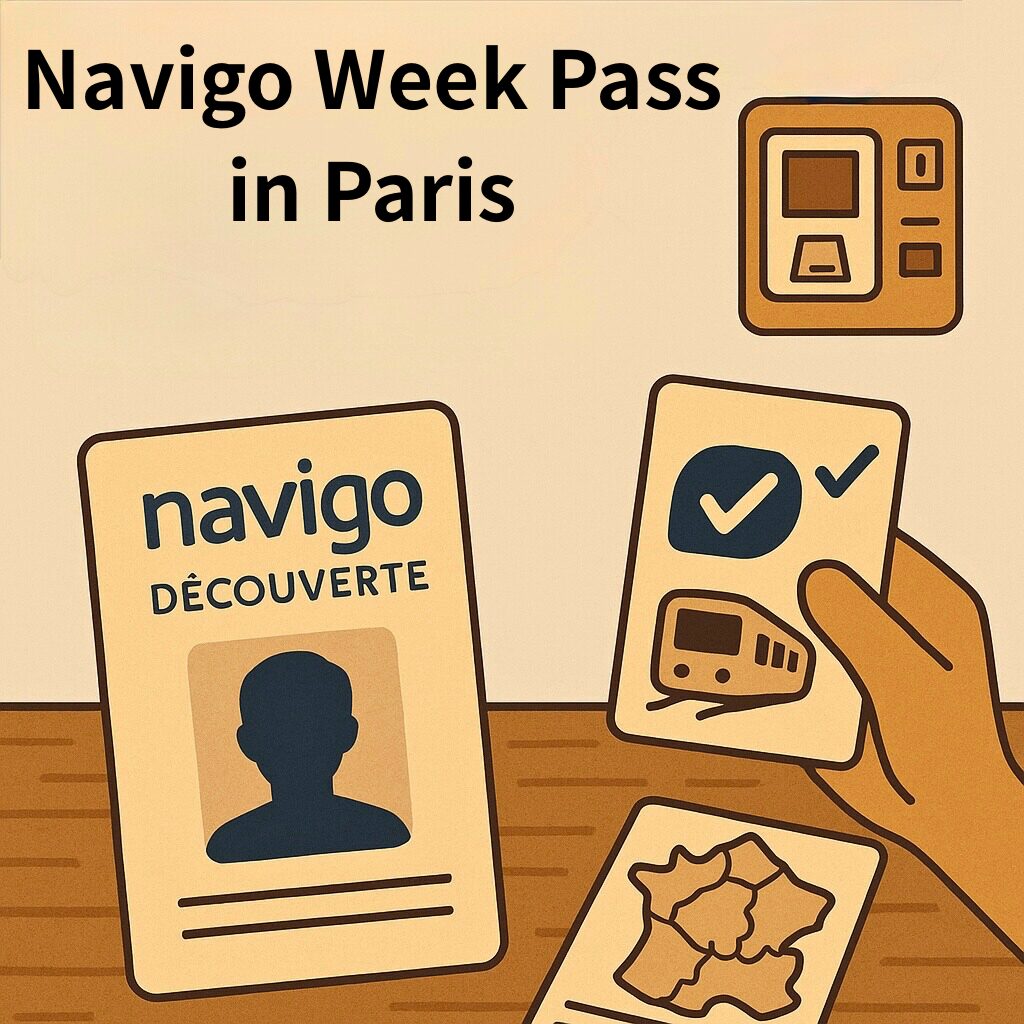
If you are staying in Paris for a week or more, the Navigo Week pass is often the cheapest and easiest way to get around.
The problem is that the system is not very tourist-friendly at first.
People get confused about the photo, the name, the machine, the validity period, and whether they can use a phone instead of a physical card.
This guide is based on my real experience using it in Paris, plus the current 2026 rules.
So instead of repeating vague official wording, I will focus on the parts that actually confuse travelers.
If you are still planning your Paris trip overall, see my Paris category first.
If Paris is only one stop in a longer train trip, you may also want my Eurostar luggage guide.
- Quick Answer
- Who Should Get the Navigo Week Pass
- The First Important Rule: It Is Monday to Sunday, Not 7 Days
- Price in 2026
- Physical Card or Smartphone? Both Exist Now
- How I Bought It: Counter Is Easier for First-Time Travelers
- There Are Two Types of Machines, and That Confuses People
- The Most Important Tourist Trap: Identity Requirements
- Photo: Yes, This Is the Part People Forget
- Ticket Inspection Is Not Rare
- My Real Take: The Pass Is Excellent, but the System Is Annoying
- When It Is Worth It
- When It May Not Be the Best Choice
- Final Verdict
- Related Articles for Paris and Beyond
Quick Answer
- The Navigo Week pass is valid for a fixed Monday to Sunday week, not for 7 days from the moment you buy it.
- In 2026, the all-zones version costs €32.40.
- It works well if you stay at least several days and move around a lot, especially if you are based outside central Paris.
- If you use a Navigo Découverte card, you need to treat it as a personal pass with your identity details.
- You can now also use the pass on your smartphone for the all-zones version, but many travelers still end up using a physical card.
- The biggest tourist mistake is thinking: “I bought it, so I’m done.” Usually, you are not done.
Who Should Get the Navigo Week Pass
This pass makes the most sense if:
- you are staying in Paris for about a week
- you are sleeping outside the center, such as Créteil or another suburban area
- you expect to take the metro, RER, or buses multiple times a day
- you want to stop calculating transport costs every time you move
It is especially useful when your trip includes airport transfers, suburban accommodation, repeated museum days, and long city crossings.
If your Paris stay is very short or your movements are limited, another ticket type may fit better.
But for a travel style like “move a lot, think less,” the weekly pass is strong.
The First Important Rule: It Is Monday to Sunday, Not 7 Days
This is the part many tourists misunderstand.
The Navigo Week pass is valid for a fixed week from Monday to Sunday.
It does not become valid for 7 consecutive days from the time you buy it.
That means timing matters.
Examples:
- If you arrive on Monday and stay through the week, it can be a very good deal.
- If you arrive late in the week, the value drops fast.
- If you are planning ahead, you can buy the following week’s pass from Friday.
So before buying, check your calendar first, not just your route map.
Price in 2026
For most travelers, the only version that matters is the all-zones pass.
As of 2026, the all-zones Navigo Week pass costs €32.40.
That can become good value quickly if you:
- commute from the suburbs into Paris
- take the RER several times
- make repeated day trips inside the region
- want airport-area coverage included within the relevant zones
This is one reason the pass works very well for longer, more mobile trips.
Physical Card or Smartphone? Both Exist Now
This part is more flexible than many older travel posts suggest.
You now have two broad paths:
1) Use a physical Navigo card
This is the traditional route and still the one many travelers will notice first at stations.
2) Use your smartphone
The all-zones weekly pass can also be used via the official app on a phone.
In practice, though, many first-time travelers still end up using the physical route because:
- they are already standing in a station and want to solve it immediately
- machine flow is easier to understand on the spot than app setup
- they prefer something tangible when dealing with ticket inspections
So yes, the smartphone option exists now.
But no, that does not automatically make the process feel simple.
If you are preparing your phone setup for Europe in general, also check your connectivity backup before arrival.
Related reading: Holafly eSIM experience and backup logic
Replace this later with your dedicated English eSIM article when ready.
How I Bought It: Counter Is Easier for First-Time Travelers
I bought my Navigo Week pass at a station counter.
For a first purchase, I still think the counter is the safest option if you are tired, jet-lagged, or not in the mood to decode machine menus.
I simply said:
“Navigo Semaine”
and the staff understood what I wanted.
That is the least elegant but most reliable method.
If you already know the machine system, fine.
But for a first-time tourist, the human counter reduces the chance of buying the wrong thing.
There Are Two Types of Machines, and That Confuses People
This is one of the most useful practical details.
At stations, Navigo-related machines can look similar, but they do not all do the same thing.
Broadly, there are:
- machines for loading/recharging an existing pass
- machines that can also handle the physical card issuance flow
If you are trying to create everything from zero, not every machine is equally helpful.
That is why many travelers think the system is broken when the real issue is simpler:
they are standing in front of the wrong machine.
If you do not want to gamble on station UI design, go to the counter.
The Most Important Tourist Trap: Identity Requirements
This is where people get sloppy.
A weekly Navigo used as a personal pass is not just a random reusable ticket.
It is tied to a person.
That means identity-related details matter.
From a tourist point of view, the practical lesson is simple:
Do not assume a purchased pass is fully “ready” until the identity side is handled properly.
This is the exact type of detail people skip when they are rushing from the airport or trying to catch dinner.
Then inspection happens.
Then the day gets worse.
Photo: Yes, This Is the Part People Forget
When I used the physical card route, the photo issue was real, not theoretical.
A lot of travelers underestimate this because they are used to cities where transport cards are anonymous.
Navigo Week is different enough that this assumption can backfire.
You can usually take the photo at the station
At larger metro or RER stations, you can often find photo booths.
So this is not an impossible problem.
You do not need to carry glue
On the card side, the photo area is designed for attachment.
So glue was not the issue for me.
But you may need scissors
This is the kind of annoying detail travel guides often leave out.
The photo format and the real-world handling are not always “perfectly ready” the second it comes out.
So yes, a tiny practical tool can matter more than the official explanation.
This sounds trivial until you are standing in a station trying to finish the setup with no scissors.
Ticket Inspection Is Not Rare
This is another reason I would not write a soft, “don’t worry about it” article.
I ran into inspection after only a few days of using the pass.
And on that day, checks happened multiple times.
So this is not just a theoretical rule hidden in fine print.
Tourists do get checked.
If your setup looks incomplete, the risk is not abstract.
That is why I would treat the identity/photo side seriously from the beginning instead of assuming nobody will care.
My Real Take: The Pass Is Excellent, but the System Is Annoying
This is the honest conclusion.
Once the pass is working properly, it is excellent.
You stop thinking:
- “Should I save this ride?”
- “Should I walk instead?”
- “Is this transfer worth the extra ticket?”
That freedom matters more than the official marketing language.
But the system around the pass is not elegant.
It is one of those classic travel tools that becomes powerful only after you get past the setup friction.
So the real question is not:
“Is the pass good?”
It is:
“Can I get through the stupid part once, so I can enjoy the useful part for the rest of the week?”
Usually, the answer is yes.
When It Is Worth It
The Navigo Week pass is worth serious consideration if:
- you are staying long enough to use transport heavily
- your accommodation is outside the center
- you plan to use metro + RER + buses without overthinking every ride
- your trip includes movement-heavy sightseeing days
It is also a good mental-energy saver.
And that matters more than many people realize on a real trip.
Transport systems are not only about money.
They are also about how much friction they remove from your day.
When It May Not Be the Best Choice
You may want to reconsider if:
- your Paris stay is very short
- you arrive late in the weekly validity cycle
- you barely plan to move around
- you want the absolutely simplest setup with the fewest moving parts
In those cases, the weekly pass can be more system than you need.
Final Verdict
The Navigo Week pass is one of the best-value transport tools in Paris if your dates and movement pattern fit it.
The key points are:
- check your calendar first
- remember it is Monday to Sunday
- do not ignore the identity/photo side
- use the counter if the machine flow feels unclear
- understand that inspection does happen
Once you clear those obstacles, the pass becomes very comfortable.
It is not glamorous.
It is not especially tourist-friendly.
But it is practical, and practical wins.
Related Articles for Paris and Beyond
If Paris is one part of a bigger Europe trip, these may help next:
- Eurostar Luggage Rules (2026): Size Limits, How Strict They Are, and Why 65L Beats 90L
- Day 28 – Eurostar to London: Seat Trouble, Plus-Class Meal, and the Reality After Arrival
- Paris category
Future internal links to add when published:

コメント