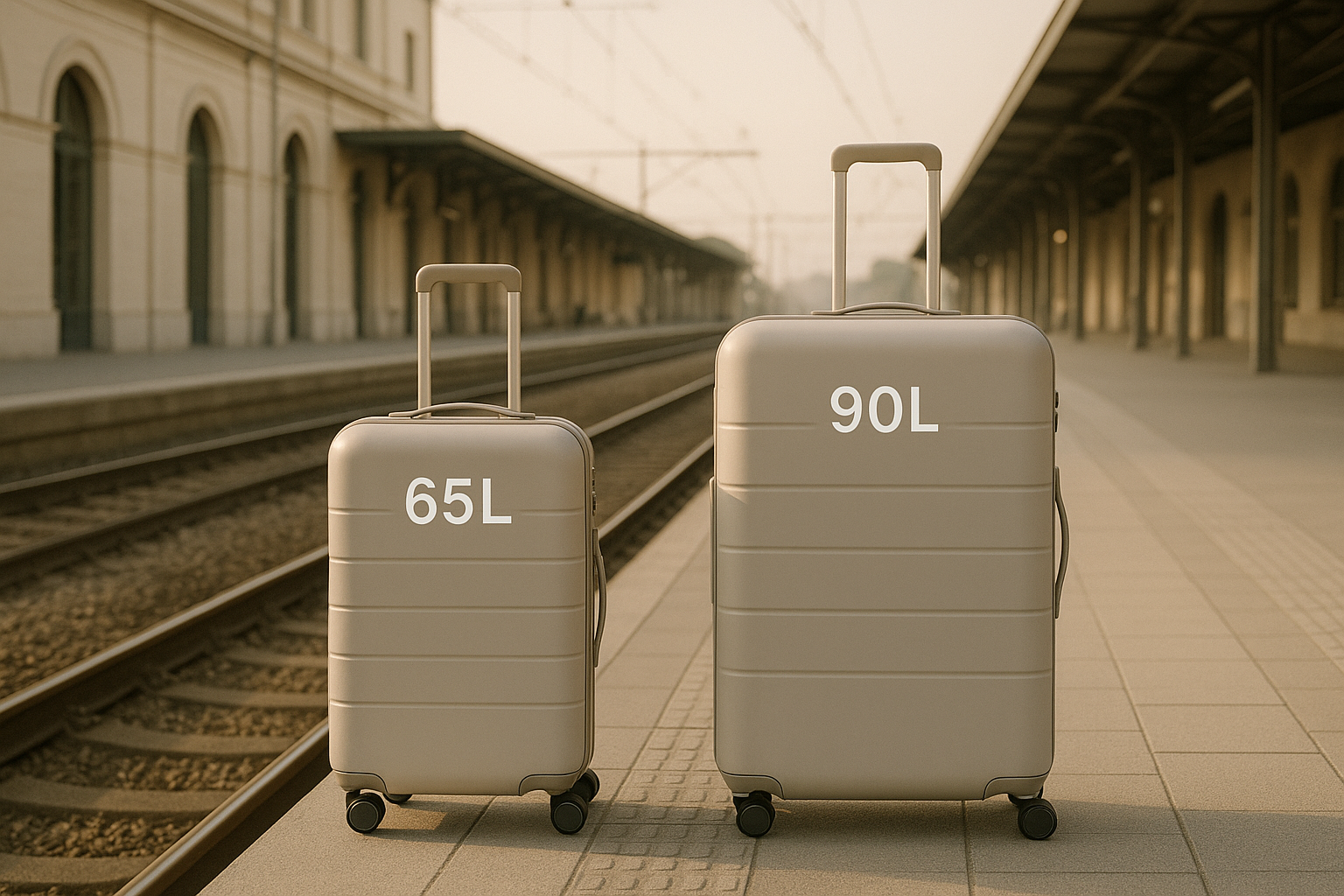
Before this trip, I half-assumed that bigger would be safer.
If I was going to spend 7 weeks moving around Europe, a larger suitcase seemed like the safer choice. More room, fewer compromises, less stress.
After actually doing the trip, I ended up thinking the opposite.
A 60L suitcase was not perfect, but it was the most practical starting point. What mattered most was not how much I could pack on day one. It was how manageable my luggage felt when I had to drag it across cobblestones, carry it up stairs, and deal with train stations that were not designed to make luggage easy.
That was the real shift for me. The question stopped being “How much can I fit?” and became “What can I realistically handle while moving?”
- The short version
- I started with 60L, and that part was fine
- Why 60L worked better than I expected
- The real problem was not durability. It was volume.
- Why I would not plan around two suitcases from the start
- Why 90L stopped feeling like a good idea
- The setup I would choose again
- My recommendation by travel style
- Do not forget airline weight limits
- Final verdict
The short version
- 60L felt like the most practical base size for a long Europe trip
- 90L gives you more space, but becomes harder to manage on trains, stairs, and transfers
- If your luggage grows later, adding a small extra suitcase is usually easier than dragging one oversized case for the whole trip
I started with 60L, and that part was fine

I began the trip with one 60L suitcase, and in the beginning, I had no real problem with it.
What changed was not my clothes. It was everything else.
As the trip went on, I started picking up food, wine, fabric items, paper goods, and small purchases that did not look dramatic on their own but slowly took over my luggage. That gave me a much clearer sense of three realistic setups:
- one 60L suitcase
- one 90L suitcase
- a 60L suitcase plus a second small suitcase added later
After dealing with those realities in actual travel, I came away thinking that luggage choice depends less on raw capacity and more on how you move through the trip.
Why 60L worked better than I expected

The suitcase I used was not a premium model. It was a low-cost hard-shell suitcase in the budget range, and that mattered because one of my assumptions before the trip was that Europe would destroy it.
That did not happen.
It got through cities like Paris, Rome, and Berlin without any major trouble. The wheels kept rolling, the body did not warp, and nothing broke. Mine had double wheels with an 8-wheel setup, and I do think that helped. If I were choosing a suitcase for Europe again, that is one feature I would pay attention to.
That does not mean every cheap suitcase is good. But after actually dragging mine across European streets, I stopped believing that Europe automatically requires a high-end suitcase. Cobblestones are annoying, yes. They are not pleasant. But in my experience, they were not an automatic reason to buy something expensive.
The real problem was not durability. It was volume.

Before the trip, I thought clothes would be the main packing problem.
They were not.
The things that gradually took over my suitcase were:
- wine and other bottled items
- packaged food
- books, brochures, and paper goods
- fabric items and small miscellaneous purchases
Clothes can be reduced. Souvenirs usually cannot.
That is why I would not call 60L perfect for a 7-week trip. If you shop along the way, it may stop being enough. But it still felt like the best size for the part of the trip that involved the most moving around.
Why I would not plan around two suitcases from the start
Once I added a second suitcase, the disadvantages became obvious very quickly.
Two suitcases sound manageable when you picture flat airport floors and short walking distances. Actual travel is different. Stations are crowded, accommodation is not always convenient, and sometimes there is nowhere to pause and reorganize.
The main problems were simple:
- carrying both pieces up stairs
- moving more slowly inside stations
- losing the use of both hands
- getting more tired during each transfer
One of the worst moments was carrying luggage up to the fifth floor in an older European-style building with high ceilings. Each flight felt longer than expected. With one suitcase, it was already irritating. With two, it became the kind of task that makes you immediately question your packing decisions.
That is why I would not build a whole trip around two suitcases unless I already knew I would be moving very little between places.
Accommodation matters here too. Stairs, elevators, and room space can change how manageable your luggage feels. I wrote about accommodation choices based on my 7-week trip here: Europe accommodation guide.
Why 90L stopped feeling like a good idea

If 60L may become too small, the obvious alternative is to start with a 90L suitcase and avoid buying another one later.
I understand the logic. On paper, it makes sense.
But Europe changes that calculation.
The problem shows up the moment you need to lift the suitcase, store it, or move it through older stations and stair-heavy transit systems.
A 90L case gives you more room, but it also creates more friction:
- it may not fit easily on train luggage racks
- large luggage areas can fill up quickly
- once fully packed, it becomes much harder to lift
- it is more awkward in older stations, narrow hotel spaces, and small elevators
On trains, I kept noticing how limited luggage space could be. Even when there was a luggage area, it did not always feel generous. I would not have wanted to force a fully packed 90L suitcase into a crowded setup like that.
I also kept thinking about stairs, especially in Paris. Stations near places I actually used, like Porte de Clignancourt and Anvers for Montmartre, did not have escalators or elevators in the way that would make large luggage feel easy. On flat ground, a large suitcase can feel manageable enough. That is not the issue. The issue is everything around the flat ground. Once stairs enter the picture, the size starts to matter much more.
That was the point where 90L stopped feeling practical to me.
For car-based trips, taxi-heavy travel, or longer stays in one place, 90L may still make sense. But for a trip that feels like train, station, stairs, hotel, repeat, it starts to feel like too much luggage.
The setup I would choose again
If I were doing the same kind of trip again, I would still start with 60L.
It was easier on trains, easier on stairs, and easier to live with while changing cities. Then, if shopping or souvenirs started taking over near the end of the trip, I would add extra capacity later instead of carrying it for seven weeks just in case.
That felt like the most realistic balance between preparedness and mobility.
My recommendation by travel style
Choose a 60L suitcase if…
- you are traveling around Europe mainly by train
- you will change cities often
- you expect stairs, walking, and uneven streets
- you want the best balance between capacity and mobility
Start with 60L, then add a small extra case later if…
- your trip is long
- you know you tend to buy food, wine, gifts, or home items
- you want to stay more mobile during most of the trip
- you do not want to drag extra luggage around from day one
Consider 90L only if…
- you move mostly by car or taxi
- you stay in one city for longer periods
- you rarely need to carry luggage up stairs
- you care more about maximum capacity than ease of movement
Do not forget airline weight limits
More space does not automatically make a suitcase easier to use.
Once you start adding bottles, food, books, or bulky purchases, weight can become a problem before volume does. Many international airlines use 23kg as a standard checked baggage limit, and that matters more than people expect. A 90L suitcase may give you more room, but it also makes it easier to cross the line where the bag is no longer practical to lift, carry, or check without extra cost.
That was another reason 60L felt more realistic to me. It was easier to manage physically, and it felt less likely to create problems with normal checked baggage limits.
Final verdict
After 7 weeks in Europe, I would still start with a 60L suitcase.
Not because it solves everything, and not because 90L is always wrong. I would choose it because it felt like the easiest size to live with while actually moving through Europe.
And if my luggage grew later, I would still rather add a small extra suitcase near the end than drag one oversized suitcase through the whole trip.
If your trip involves trains, stairs, transfers, and walking through real cities rather than ideal travel conditions, 60L is the size I would start with.
If your trip includes the Eurostar, also check how luggage works on board before booking: Eurostar luggage rules and storage guide.


コメント